April 2004 – July 2004
When I moved up to the farm, two things stood out right away.
The first was the absence of the trees in front of the farmhouse. One had been a pine, the other an oak. They’d stood there for as long as I could remember, providing shade to the porch and giving the place a lived-in, anchored feel. Without them, the house looked bare. Naked. It reminded me of the kind of houses you’d see on the grain plains, exposed and lonely, with no trees to break the wind. It hurt to see them gone. They were tied to memories of Aunt Mary, and their absence was just another reminder she was no longer there. I told my dad how I felt, and he understood—but he explained we needed the space to install the septic system. Practicality won out, but the sight still stung.
The second change was Dale Eagle.
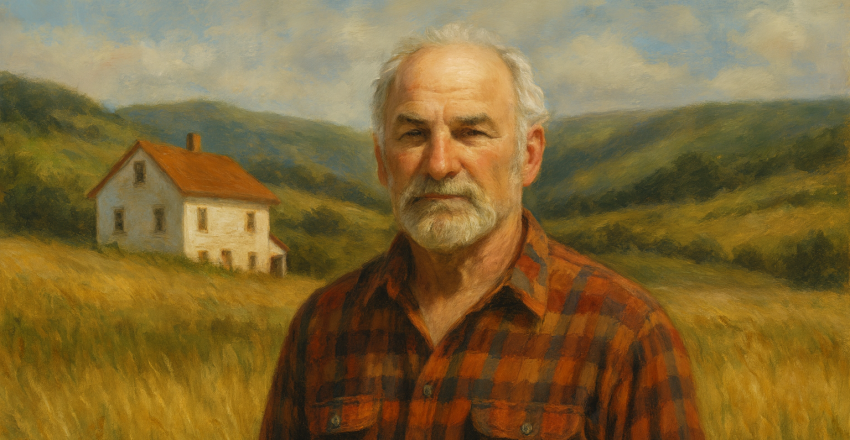
Dale lived at the end of the road that led up to the farm. He was an older man in his early sixties—short, bald, with a big nose, beady black eyes, and a short white beard that made him look like a yard gnome. His soft, high-pitched voice carried a country drawl that was very disarming. He and his wife had been living there since the early ’90s, and he told us he was a retired coal miner living off disability after developing a bad heart.
The first time I saw him riding a four-wheeler up on the property, I didn’t think much of it. I assumed it was a one-off. But then he came back the next day. And the day after that. That’s when it struck me as odd. Before this, I had only seen Dale maybe two or three times in my life—once at Aunt Mary’s funeral, and once when he and Dad were digging the waterline, which I remember thinking must have put strain on that so-called bad heart. Now, suddenly, he was a daily presence, his four-wheeler buzzing across the farm like he owned the place.
My parents didn’t mind. They had been friends with Dale and his wife for a while, even gone to their house for dinner. To them, his constant visits weren’t unusual. They found him charming, even kind. To me, it was a change that set me on edge.
I couldn’t shake an uneasiness about him. Aunt Mary had warned us more than once that Dale “couldn’t be trusted.” She said he was “crazy like a fox.” Coming from her—a woman who rarely spoke ill of anyone—that carried weight. But my parents ignored it. They thought Dale was a great guy. They brushed off his quirks and eccentricities as harmless rambling.
Every time I pushed back, their answer was the same: “That’s just Dale.”
It felt like I was the parent warning my kid not to play with a questionable friend. Only in this case, my parents were the ones keeping company I didn’t approve of.
Dale liked to claim he was helping out. He’d say he was clearing debris and fallen branches from trails, though that was the kind of chore you did after a storm, not every single day. He even planted trees on our property without asking. When I questioned my parents about it, their response was the same: “That’s just Dale.”
He often played the part of the unlucky man, lamenting how life had treated him unfairly, how nothing ever went his way. He was like a real-life Charlie Brown, always losing, always the victim of fate. With his soft drawl, it was easy to feel sorry for him. Easy to be lulled into empathy.
I almost fell for it—until his comments started crossing lines.
One day, in the middle of another one of his “poor me” monologues, he casually mentioned how disappointed he was that Aunt Mary hadn’t left him anything in her will. “After all I did for her,” he said matter-of-factly, “it’s sad she didn’t leave me something.”
I stared at my parents, wide-eyed, waiting for them to be as shocked as I was. But their faces didn’t change. They didn’t react at all. It was as if we weren’t even hearing the same words.
That moment hit me like a slap: they weren’t hearing what I was hearing.
A few weeks later, my parents were in Salem with the alpacas when Dale rolled up again. I had just broken my wrist days earlier and was resting in the 5th wheel when I heard the familiar buzz of his four-wheeler.
I stepped outside to meet him.
“Your parents home?” he asked, still sitting on his machine.
“No,” I said flatly.
That’s when his tone shifted. “Working on this house and those alpacas costs a lot of money, huh?”
“I guess so.”
“So how much money you think your dad has in all of this?”
“I don’t know, Dale.”
It wasn’t threatening—but it wasn’t casual either. He was probing. Fishing. Asking the kind of open-ended questions that made me feel like he was trying to size up my parents’ finances.
I wasn’t scared—I knew the 5th wheel was safe, and Dad’s handgun was in the drawer if I needed it. But I was annoyed. Suspicious. My wrist throbbed as I told him I wasn’t feeling well and needed to lie down. He finally turned the four-wheeler around and left.
When my parents came back, I told them everything. “I don’t want Dale on the property when I’m alone,” I said. “He’s asking weird questions. About money. About you.”
For the first time, they didn’t say, “That’s just Dale.” They just looked sad. “Okay,” Mom said quietly.
For a moment, I thought I was finally getting through to them. But the truth was, nothing really changed. Dale kept coming around.
Not long after, Dad and I were working outside the house when Dale showed up again. Dad walked him around, proudly showing off the progress. When we got to the carport where we stored our supplies, Dad noticed something: a set of sink fixtures was missing.
It wasn’t the first time things had gone missing. Tools, wiring, odds and ends—always stuff that could be sold for scrap. Around Four States, people suspected two local brothers of that kind of grab-and-go theft, but no one could ever prove it. Dad mentioned it aloud in Dale’s presence—not as an accusation, just as a statement. Then we moved on. Dale stayed for another half hour and then went home. Nothing seemed out of the ordinary.
And then we didn’t see him again for two weeks.
At first, I felt relief. No more four-wheeler, no more boundary-crossing conversations. But soon that relief gave way to concern. My parents were worried too. For all my misgivings about Dale, he was their friend. If he was laid up for two weeks, it was probably something serious—maybe his heart.
Dad called down to check on him. His wife said he was sick. A few days later, Dad even cut a branch from a cherry tree Dale liked and offered to bring it by. Still, no sign of him.
Not long after, Mom and I drove down to Spartanburg to visit my grandparents. Pepaw’s birthday was coming up, and with college and everything else, it was easier to celebrate early.
We surprised them in the afternoon and that evening went out to Golden Corral—me, Mom, my grandparents, Uncle Gene and Aunt Beck, Aunt Theresa, and my cousin Matthew. Dinner was lively, full of laughter and teasing. My mom’s side of the family could really come alive over food.
Then Mom’s cell phone rang.
“Hi, hun,” she answered cheerfully.
There was a long pause as she listened.
Her expression shifted. Her eyes widened. Her mouth dropped open.
“Oh my gosh! Are you okay?”
The table fell silent. My heart dropped. My first thought was that Dad had been hurt working on the house alone.
“Okay. We’ll head home right now!” “Be safe. I love you! Bye!”
My mom closed her cell phone and sat there in absolute shock. All of us were staring at her waiting for my mom to say something. Finally I asked my mom what happened. She turned and looked at me then she said the words that froze the whole room:
“Dale pulled a gun on your dad!”