August 2004 – October 2004
I should start with a history lesson.
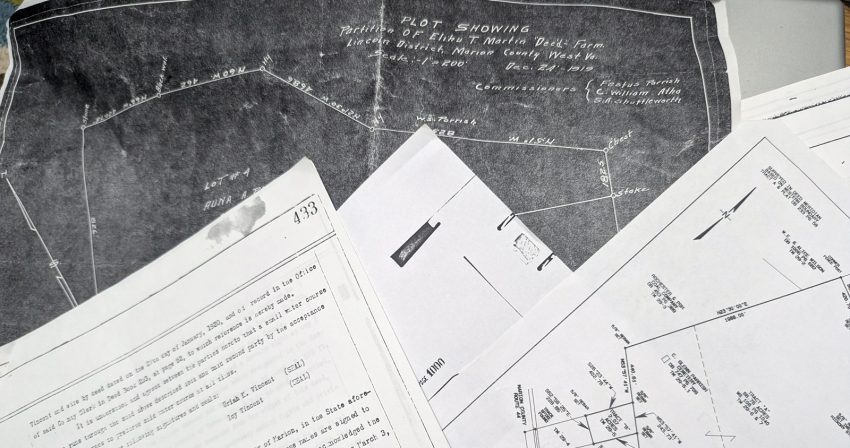
The farm used to be one piece, owned by a man named Jacob G. Martin. His land stretched all the way to the county road, with a carriage road winding through the hills toward the center of the property, and giving access to the family cemetery where he now rests. After Jacob’s death in 1918, the land became tangled in litigation and divided among his nine children. Over the next few years, two brothers — Elihu and A.F. Martin — began buying out the shares of their siblings until they held much of it themselves.
For reasons that time didn’t bother to record, the Martins sold a large portion of the farm to my ancestor Steve “Stipa” Markovich in 1927. Stipa worked at the local Four States mine, and by all accounts was a rough fellow — the kind of man who didn’t mind hard work or harder drink. There’s even an old story about the police chasing Uncle Stipa up the right of way after catching wind that he’d been making moonshine. I like to imagine him thundering up that same carriage road, the hooves of his horse kicking up gravel, the shouts of deputies fading into the trees.
The deed from that sale included both mineral rights and a right of way to the county road — recorded in Book 233, Page 52.

Over the decades, parcels were sold, boundaries redrawn, and eventually, the main part of the farm became landlocked. But for generations, it never mattered. The road remained open and understood — a thread of earth connecting us to our family’s past. No one questioned its use. No one fought over it. Until Dale Eagle moved in.

That old carriage road still looks much the same as it probably did a century ago: a narrow strip of dirt carved between granite and trees, with a steep drop into a ravine on the left as you climb the hill. When I walk it now, I imagine the echoes of hooves and wagon wheels, a century of Martins, Markoviches and Slatts coming and going, unaware that one day this quiet road would become the line where friendship, pride, and legality collided.
The Lovely Neighbor
On July 23rd, a peace bond was issued against Dale Eagle. It was a simple understanding: if he left us alone and we left him alone, there’d be no trouble. If Dale broke the peace, a complaint could be filed, and the magistrate would decide whether the bond had been violated. If Dale broke it, he’d lose his deposit and face additional fines.
But peace was never really Dale’s strong suit.
On August 13th, the police came up to the farm. Dale had called them, claiming we were trespassing — that we were using a right of way meant only for a gas company called Exploration Partners. According to him, we had no authorization to set foot on it. My dad met the officers at the end of the road, along with a representative from the gas company. While they talked, Dale showed up, red-faced and puffed up, insisting we had no right to use the road. What we didn’t know then was that Dale had already struck a deal — one that would cause months of turmoil.
That road had been there long before West Virginia was even a state. But Dale had convinced Exploration Partners that he owned it outright and could sell them an easement to use it. They, in turn, never did a proper title search. They took his word as fact.
A day later, on August 14th, my dad stood near one of the wells on our property with a gas company worker when Dale roared up on his four-wheeler. He drove about fifty feet onto our land, stopped, and stared at them without saying a word. Then he brushed back his jacket just enough to expose the pistol at his side. Without a word, he turned around and drove back down the right of way. The gesture said what words didn’t: this was going to be a fight.
By September 20th, the tension boiled over again. My dad was parked near the road, talking with a man he hoped to hire for some work on the farm, when Dale’s truck came barreling up behind them, horn blaring. My dad waved for him to go around, but Dale got out instead, trying to draw the other man into an argument. When that didn’t work, he stormed toward my dad, fists raised like he meant to start something. My dad — steady as always — told him, “Don’t do it, Dale. Remember what happened last time you picked a fight?”
Dale’s hands dropped, but his mouth didn’t. He accused my dad of liking to “beat up old people,” cussed him out, then jumped back into his truck and sat there laying on the horn until he’d run out of steam. Later that afternoon, a policeman stopped by the farm. Dale had filed a complaint claiming my dad had threatened him. The officer listened, nodded, and left with a quiet, “Have a good day.”
At the dinner table that night, my parents talked about it with a mix of irritation and disbelief. I wasn’t there for most of these encounters — I was either at school or working — but my dad kept notes in a daily planner. Those scribbles, and my parents’ retellings at church and over supper, painted the same picture every time: exasperation laced with a bit of grim humor. Dale was becoming a problem, but no one expected just how far he’d go.
The Blue Letter
On October 4th, I came home from class to find my parents sitting at the kitchen table. They weren’t angry — not exactly — more irritated in that bemused, “you’ve got to be kidding me” way. My mom held up a letter and said, “Get a load of this!”
The envelope was ordinary, but the ink inside was a deep, almost cheerful blue — the kind of color you’d use for birthday invitations, not quasi-legal ultimatums. My dad read it aloud, shaking his head as if it were some bad joke. We all laughed at first. Then, as the words sank in, the laughter faded.
Dear Mr. Slatt:
On July 2004, I encountered you talking to two county policemen on my driveway near my garage. At that time, you asserted that you had a thirty (30) foot easement over my driveway for ingress and egress through my property.
Please be advised that title search shows no such easement. Further, the title search shows that the gas company has an eight (8) foot ingress and egress easement over my driveway conveyed to them. The gas company recently informed me that they have not agreed to let anyone else utilize their easement rights.
Years ago, I orally consented to let Mary Slatt, former fee owner of property you now purport to own, to use my driveway to access her land from time to time so long as she agreed to help maintain the driveway, let me hunt on her land, and ride my four-wheeler and/or I withdrew my consent.
This letter is to notify you that you as successor owner of that property have no legal right to utilize my driveway or any of my property for purposes of ingress or egress, nor can [you] utilize the easement granted the gas company. Unless and until we agree in writing in recordable form, please find other means to access your land. You herein have thirty (30) days to stop using my property and find alternative means of access.
Yours truly,
Dale Eagle
The Facts Don’t Line Up
First off, Dale couldn’t even get the date right. He claimed the incident happened in July 2004 — it was August. A small detail, sure, but telling. When your story starts off wrong, how much else can anyone trust?
Then there was his claim that my dad had asserted we had a “thirty-foot easement.” My dad never said anything of the sort. He never needed to — the road had never been in dispute until Dale decided it should be.
What really happened, we later learned, was even worse. Exploration Partners, the gas company, never performed a proper title search before cutting their deal with Dale. They took his word for it when he said he owned the right of way. In doing so, Dale suckered a gas company into paying him for an easement he had no right to grant. That’s not just dishonest — that’s skating dangerously close to fraud. You can’t sell or transfer rights to land you don’t own. Any easement created under false pretenses can be challenged, even voided entirely.
And then he went and dragged my late Aunt Mary into it — claiming she had made some kind of oral agreement with him to use the road. That was a new one. Aunt Mary never mentioned any such arrangement. Not in her will, not in conversation, not in her piles of handwritten notes we went through after she passed. Invoking her name that way — to prop up a false claim — was low. Aunt Mary deserved better than that.
Then there was that phrase — “purport to own.” As if our inheritance was some illusion. As if we’d dreamed the deed. We didn’t purport to own anything. We inherited the farm, fair and square, through the family line. The land, the farmhouse, the cemetery — and yes, the road that led to it — are all part of that legacy. Our right of way was conveyed decades before Dale was even born.
Easements, Rights, and What the Law Actually Says
For anyone who’s never had to deal with rural property disputes, here’s the short version of how easements work:
- You can’t grant an easement on land you don’t own.
- If a road has been used openly and continuously for 21 years or more, it can qualify as a prescriptive easement — a right recognized through long-term use.
- Permission cancels adversity. If someone “lets” you use a road, that use isn’t adverse, so it can’t grow into ownership.
- Historic conveyances matter. If an easement was written into a deed generations ago, it doesn’t vanish because a new owner wishes it would.
In our case, the right of way was established generations ago. Nothing Dale could write in blue ink would ever erase that.
Why This Story Matters
This was never just about a road. It was about legacy — about standing up for what’s rightfully yours, even when it would be easier to give in to someone louder, meaner, or better connected. For me, it became something deeper: a defense of family, history, and truth itself.
I became protective of the farm after that — fiercely so. Every fencepost and boundary marker started to feel like a promise I was keeping for my ancestors. Driving past Dale’s house afterward always brought a flicker of discomfort — not fear exactly, but a reminder of how far some people will go to twist a simple truth into a weapon.
Dale’s real grievance wasn’t about land or law. It was about pride. After pulling a gun on a neighbor he once called a friend, he couldn’t stand the shame of it. So he turned to paper and ink, rewriting the story to make himself the victim.
That road — the same one Uncle Stipa once thundered up to escape the law — has seen its share of drama. But through it all, it endures. Granite and gravel don’t lie. They remember who walked them, who earned the right to pass, and who tried to rewrite history in blue ink.
We kept the letter — partly because we knew this wouldn’t be the end of it, and partly because of how absurd it was. Who sends a pseudo-business letter in blue ink, threatening a family over a dirt road their ancestors had used for nearly a century? It felt unserious, childish even — but beneath that, we knew it was a warning shot. It was time to call a lawyer.